Standardised procedures for recognising and managing suspected and diagnosed concussion across all levels of Australian Taekwondo competition and training — built to keep our athletes safe.
Concussion is a brain injury that causes a disturbance of brain function. It usually follows a head impact but can occur with impact to other parts of the body, and it can happen without loss of consciousness. Symptoms may come on at any time, but usually within 24–48 hours of a collision.
Children and adolescents are more susceptible to concussion, take longer to recover, and must be treated more conservatively than adults. Every member of the Australian Taekwondo community is responsible for recognising the signs of concussion and managing it appropriately.
Under this policy, suspected and confirmed concussion are treated identically. Any athlete with a potential head injury or suspected concussion must be removed from play and training, and is not permitted to return on the same day.
Concussion that is ignored or not recognised can be fatal — including from a single or second impact. All concussions and suspected concussions must be taken seriously. When in doubt, remove the athlete and seek medical assessment.
A coach does not diagnose concussion. Your role is to recognise it, remove the athlete from risk, support medical assessment, report the incident, and prevent a premature return.
Know the observable signs and symptoms. Take any concern seriously.
Stop participation immediately. Never let an athlete "test it out".
Arrange medical assessment. At events, follow the medical team's direction.
Complete AT concussion reporting and retain the documentation.
No return until stand-down, graduated return and medical clearance are met.
Observable signs may be seen by others; symptoms are what the athlete reports. Any one of these after an impact is enough to act.
A contest must be suspended if any contestant is suspected to have incurred a concussion. The process runs in two phases — during the contest (on-mat) and after it (off-mat).
If the centre referee or commissioned medical doctor/associate identifies an observable sign after an impact, the contest is suspended, the clock is stopped and the medical doctor/associate is called.
The medical doctor/associate is allowed one minute for an immediate on-court concussion screen, and may request up to two minutes if required.
Suspected concussion is determined when the screen shows one or more positive indications — GCS below 15, observable signs, motor incoordination, oculomotor abnormality, or an incorrect response to modified Maddocks questions.
Coaches, team doctors and court officials must not interfere with the screening, nor overrule the medical doctor/associate's determination.
If the medical doctor/associate determines suspected concussion, the centre referee may not resume the contest.
Positive indications can only rule concussion in. An absence of positive indications on the immediate screen does not rule out the possibility of concussion.
Except where emergency hospital referral is required, an athlete with suspected concussion must be evaluated by the commissioned medical doctor in the venue medical room immediately after the contest.
SCAT6 Off-Field Assessment for athletes aged 13+ or Child SCAT6 for athletes aged 8–12, completed within 30 minutes of the incident.
Diagnosis rests on the medical doctor's clinical judgement: a plausible mechanism of injury; observable signs or acute symptoms with examination findings; and signs not better explained by other factors.
The athlete may not return to competition that day — regardless of the evaluation result or whether a concussion is ultimately diagnosed.
Report within 48 hours. The medical doctor records all evaluations and reports suspected and diagnosed concussions to the tournament director and AUSTKD Executive Board within 48 hours, via the AT concussion reporting tool.
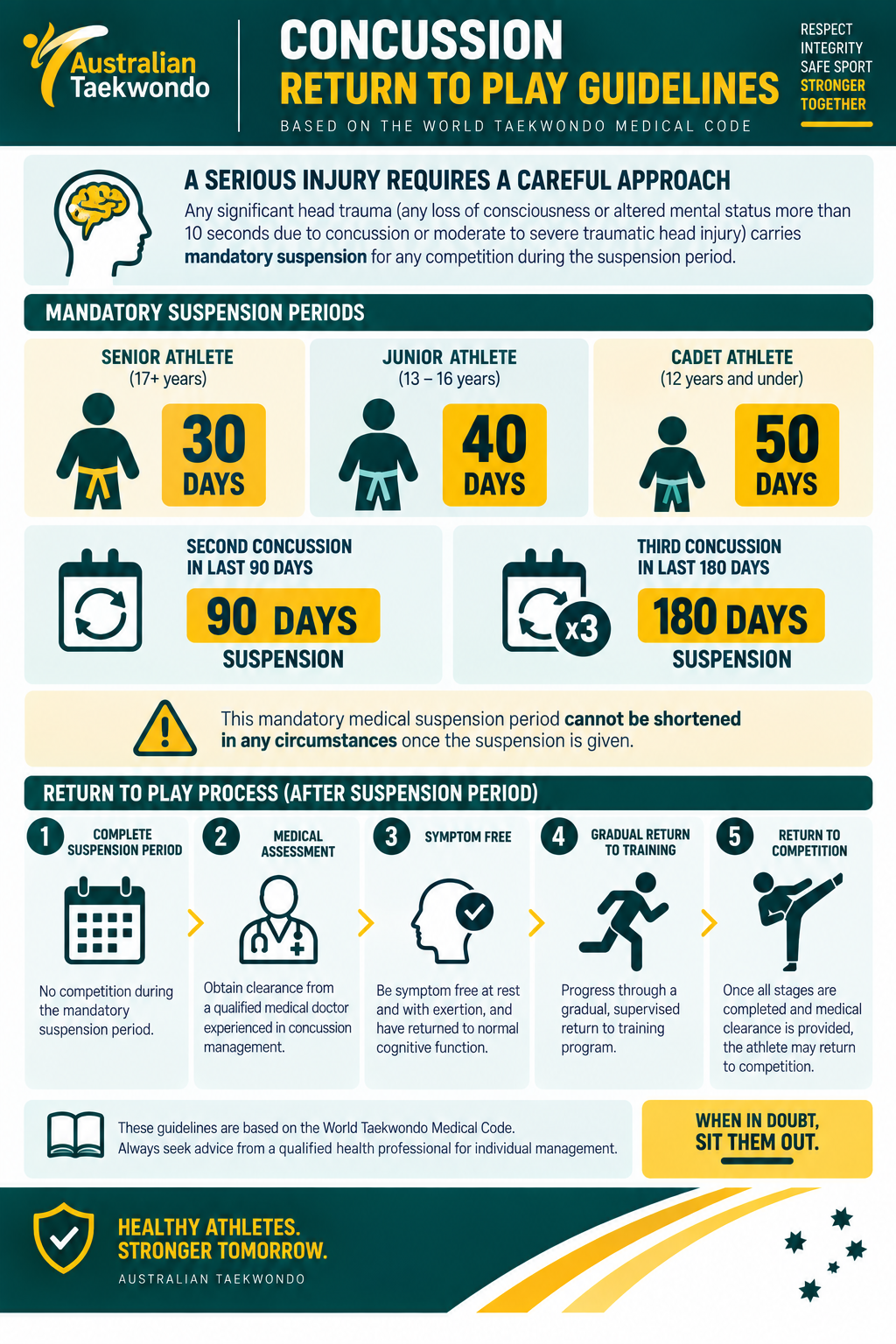
A diagnosed concussion triggers a mandatory medical suspension based on the athlete's age. This period cannot be shortened under any circumstances.
Note on age bands: These suspension periods follow the adopted AUSTKD National Concussion Policy (3 August 2026). Where an earlier return-to-play infographic shows different age bands, the adopted policy applies — the infographic is being updated to match.
After the suspension period, return happens in stages. An athlete must be symptom-free and medically cleared before returning to competition.
No competition during the mandatory medical suspension period.
Guided by a medical doctor experienced in concussion management.
Symptom-free at rest and exertion; normal cognitive function restored.
Progress through a staged, supervised return-to-training program.
Once all stages are complete and medical clearance is provided.
Ready-to-display resources for clubs, coaches and event medical teams. Click any poster to view it full size.
 ⤢ Enlarge
Mandatory suspension periods and the return-to-play process at a glance.
Being updated to policy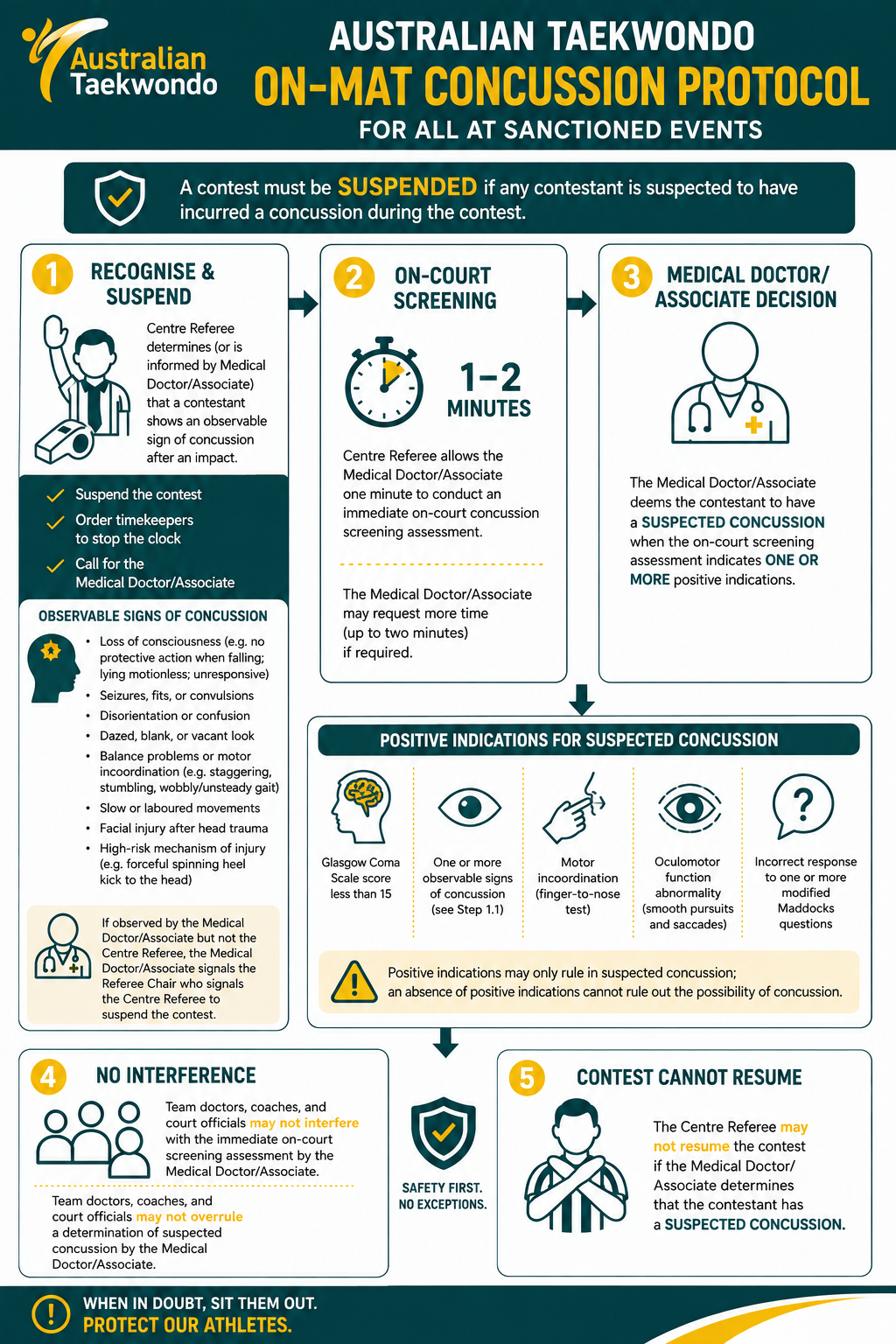 ⤢ Enlarge
The five-step process officials follow during a contest.
Competition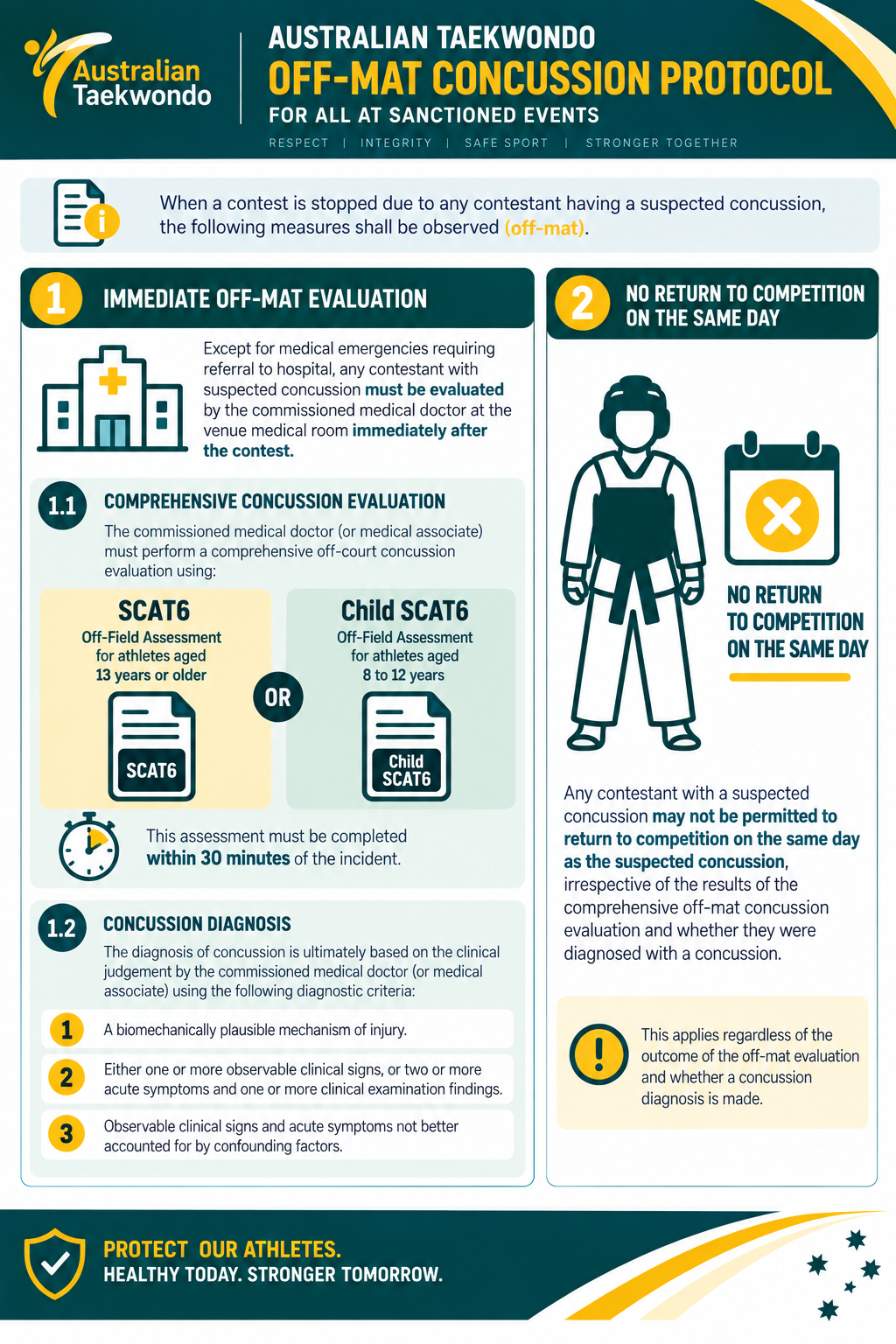 ⤢ Enlarge
Venue evaluation, SCAT6 assessment and the no-same-day-return rule.
CompetitionNeck-strengthening exercises that support head control and resilience.
Prevention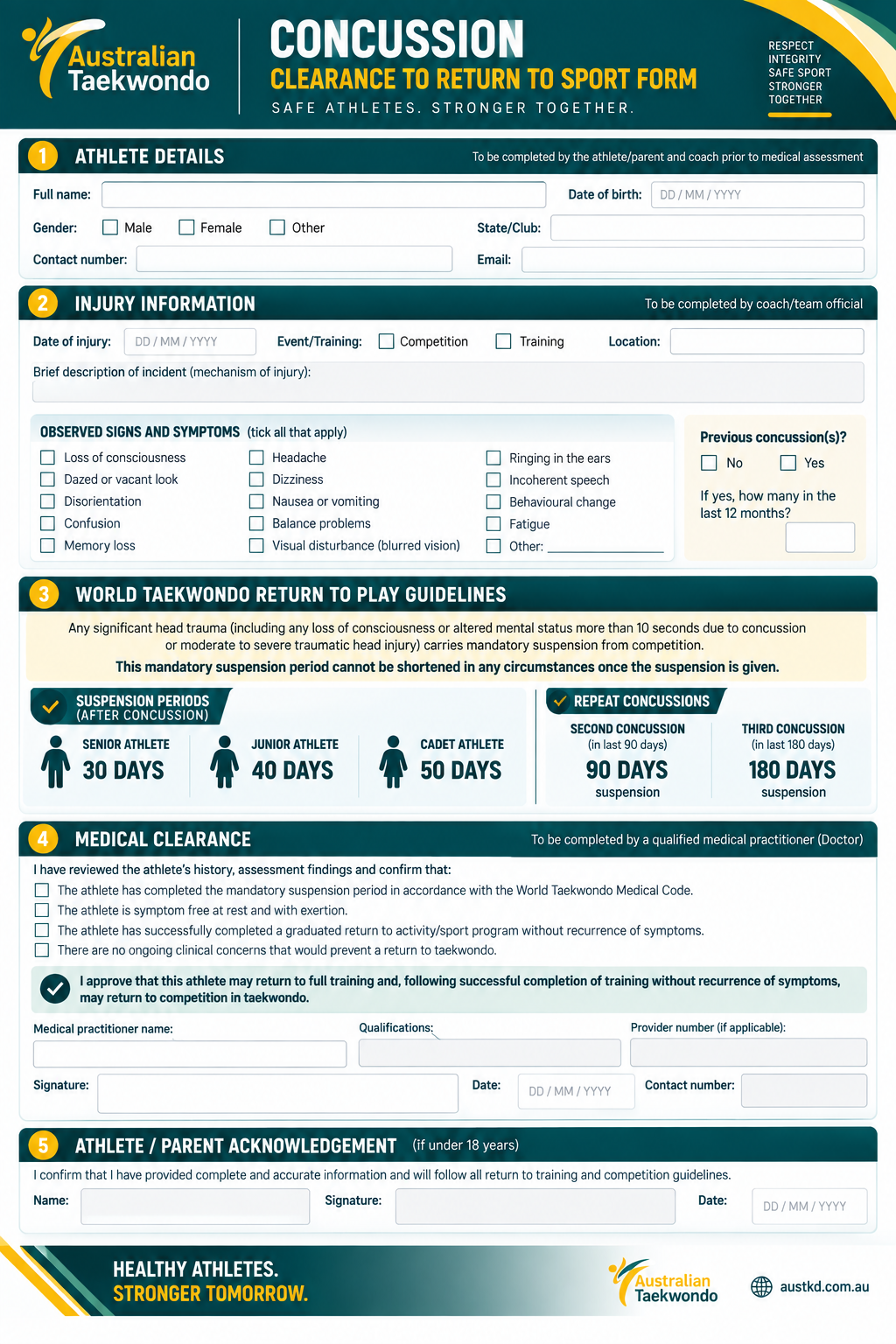 ⤢ Enlarge
Athlete, injury, clearance and acknowledgement — for medical sign-off.
FormProtect our athletes. Healthy today, stronger tomorrow.
Get the resourcesThe policy, coach guidance, clearance form and reporting pathways. Replace the file links below with your CMS document URLs when publishing.
The full AUSTKD policy — adopted 3 August 2026.
A practical guide — recognise, remove, refer, recover, return safely.
Clearance to return to sport. Submit completed forms to ben.exton@austkd.com.au.
Report every suspected and confirmed concussion online.
National guidance for youth and community sport, including graded return.
Printable resources for clubs, coaches and event medical teams.