


Following the results of the 2026 Australian Taekwondo AGM, Hassan Iskandar OAM steps into the role of new Australian Taekwondo Present. Saltis and Badreddine re-join the board for another term after a successful re-election.

Taekwondo has been a powerful outlet for Aussie kids for decades, keeping them fit and active, in a fun and engaging environment.
As the world’s most popular martial art, with over 70 million practitioners, Taekwondo is a great choice for parents hoping to teach their children key motor skills as well as important ethics and values.
While self-defence and physical empowerment are key components of the Korean Martial Art, it’s not all about breaking boards with your foot or fist.
Kids of all temperaments and personality types gain important social and leadership skills that help them to navigate life’s challenges with confidence and discipline.
Here are some of the biggest benefits of Taekwondo for children.
Physical health
Taekwondo involves a range of dynamic activities that build kids’ strength and stamina. They learn a variety of defensive and attacking combinations of kicks, punches, blocks and throws. Consistent repetition of these movements strengthens their cardiovascular fitness.
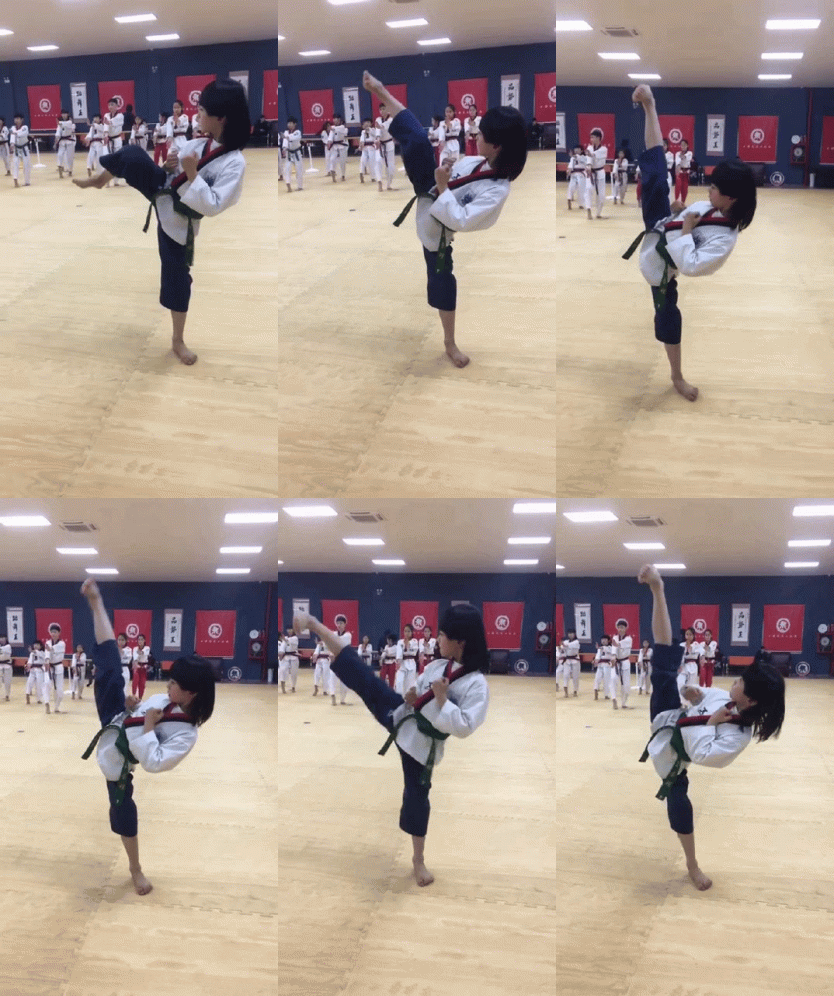
Whether they are practicing head-height kicks, spinning kicks or fast-kicking, kids are constantly improving their motor skills, hand-eye and foot-eye coordination.
Researchers in Macedonia compared the motor skills of relatively sedentary seven-year-olds with those who participate in Taekwondo. The latter group performed significantly better in every major measure - hand-tapping, foot-tapping, long jumps, sit-ups and sit-and-reach.
Unlike many sports, Taekwondo involves doing physical activities whilst barefoot, which establishes good balance and posture control. Studies have shown that kicking whilst standing on one leg creates excellent lower limb and spinal alignment, particularly in developing bodies. This includes a study that showed significant postural improvements in autistic children, who often have underdeveloped spines.
Taekwondo’s weight-bearing exercises also increase bone density, which helps kids to fend off osteoporosis later in life.
Confidence, social skills and mental health
Taekwondo clubs are an excellent environment for both shy and outgoing kids to build friendships with like-minded peers.
Most of the kids at Taekwondo classes are there because they have an interest in combat and martial arts. Learning alongside peers who share common goals gives kids a strong sense of community and belonging, which helps them to gradually come out their shell.
Researchers in Korea found that regular participation in Taekwondo had a positive effect on children from multicultural backgrounds, who had experienced isolation and bullying. Indeed, their symptoms of depression and feelings of loneliness were significantly reduced.
Further studies have shown that Taekwondo gives kids the confidence to get involved in more social activities. For example, a study of 250 high school girls, who were placed in Taekwondo classes, found that 95% of participants demonstrated rapid growth in their leadership skills and community spirit.
Kids’ self-image and mental health is also enhanced by kicking away their fear, anxiety, and repressed emotions. Tackling Taekwondo’s complex skills, which require a great deal of practice and patience, helps them to become more resilient to stress.
Focus, discipline and goal setting
From the outset of their Taekwondo journey, kids are taught the core values of discipline and respect. They learn key philosophies around peaceful conflict resolution and must follow strict social etiquette when interacting with both their instructors and peers.
Kids quickly learn that in order to perfect a Taekwondo strike or sequence, they must pay close attention to their instructor and listen carefully. This focus proves extremely useful in other areas of their lives such as school and work.
Learning complex patterns also boosts neuron growth, which improves kids’ concentration and memory. One study found that Taekwondo significantly improves kids’ academic performance because learning complex patterns boosts their brain activity and functional connectivity.
Another study showed higher levels of cognitive functioning among Taekwondo-practicing adolescents with ADHD, compared to those who did not.
For an excellent discussion of the focus, discipline and respect Taekwondo instills in all participants, watch Master Martin K. Arceo’s TED talk below.
Ethics
While Taekwondo gives kids numerous tools for self-defence, it also stresses that these skills be used ethically. At the beginning of each Taekwondo class, students recite an oath, promising to:
They then recite Taekwondo’s “five tenets”, or foundational principles:
Numerous studies have shown that kids also apply these lessons outside of class. For example, in a major UK study, 240 children aged between seven and eleven, took an 11-week Taekwondo course whilst being monitored at school for behavioural changes. The majority of teachers reported noticeable improvements in these kids’ behaviour and decision-making.
Following the results of the 2026 Australian Taekwondo AGM, Hassan Iskandar OAM steps into the role of new Australian Taekwondo Present. Saltis and Badreddine re-join the board for another term after a successful re-election.
After three consecutive terms, Jean Kfoury OAM reflects on his time as Australian Taekwondo President.
Janine Watson has called time on her 19-year taekwondo career, competing at an international level in both kyorugi and poomsae. Watson finishes as Australia's most decorated para athlete, leaving behind a legacy both on and off the mat.